Can you grow mushrooms on coffee grounds? What studies and growers say
Yes: oyster mushrooms grow on spent coffee grounds, best mixed with straw or sawdust and spawned within a day of brewing, before mold gets there first. This guide covers which species, what studies found for yield, brewing as pasteurization, mix ratios, spawn rate and moisture.

Derick12 min read
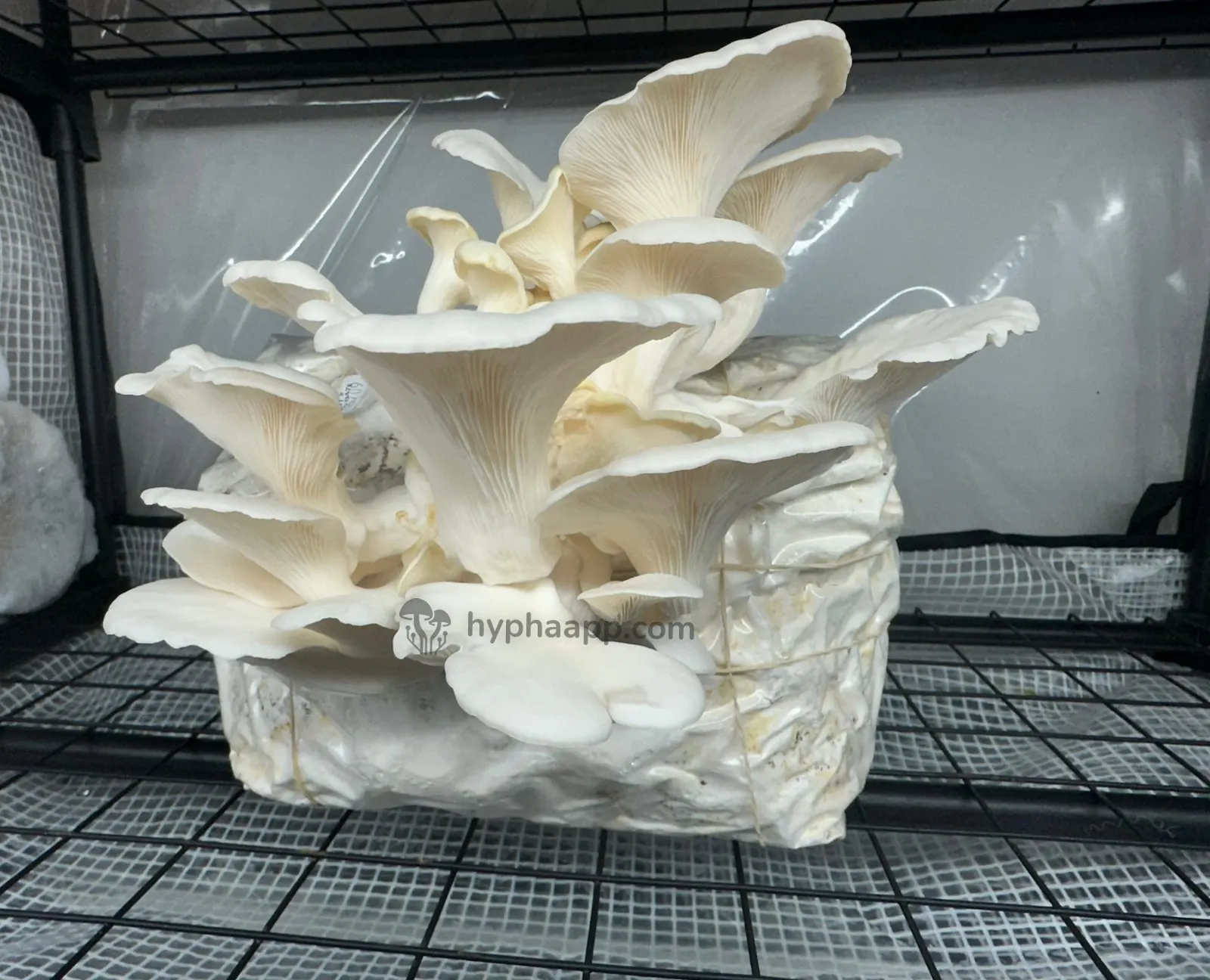
Yes, oyster mushrooms grow on spent coffee grounds, and they're the species almost every source means. The catch is time: GroCycle says to use grounds "within 24 hours of brewing", because "if the coffee is more than 24 hours old you're more likely to grow mould instead of mushrooms" (GroCycle). Grounds also work better as part of a mix than on their own. Cornell mixes them "with 50% sawdust to increase aeration" (Cornell Small Farms), and in the studies below, mixes with a third of coffee or less cropped about as well as straw alone, while mostly-coffee mixes did worse or didn't fruit. Our photos show our own oysters and mold, not a coffee-ground grow.
Sources: GroCycle, Cornell Small Farms, a Northeast SARE farm trial, Penn State Extension, America's Test Kitchen, a Kwantlen Polytechnic student trial, and peer-reviewed studies in PLoS One, Foods, Food Science & Nutrition, Applied Microbiology and Biotechnology, CyTA Journal of Food and the International Journal of Microbiology, checked 22 November 2026.
Which mushrooms grow on coffee grounds?
Oysters, mainly. Most of the evidence is for Pleurotus, and the few trials with other species are small or didn't fruit.
| Species | What sources say | Source |
|---|---|---|
| Oyster (P. ostreatus) | The species in every coffee guide and most studies | GroCycle |
| Pink oyster | Grows on "paper, cardboard, coffee grounds, mulch, soy hulls, straw or hardwood" | GroCycle |
| King oyster | "king oysters will grow on several substrates, including coffee grounds" | GroCycle |
| Enoki | "they'll grow on various organic substrates, including cardboard, straw and coffee grounds" | GroCycle |
| Elm oyster (Hypsizygus ulmarius) | Grown on straw with 10–30% grounds in a study of the mushrooms' make-up; its abstract gives no yield | Atila et al. 2026 |
| Lion's mane | A student trial on oak and bran, with and without coffee, three jars each: "No significant differences were detected between means" | Kwantlen Polytechnic |
| Reishi | Colonized but never fruited: "primordia and fruit bodies did not occur" on 91% grounds with 9% bran, or on a 25% grounds mix | Akcay et al. 2025 |
We found no shiitake trial on brewed grounds that we could read. The lion's mane trial didn't say how much coffee it used. For anything but oysters, a coffee bag is an experiment, so run it beside a bag on your usual substrate (our advice).
How much do oysters yield on coffee grounds?
About as much as on straw when coffee is a third of the mix or less, and less, or nothing, when it's most of it. If biological efficiency (BE) is new to you, our BE guide explains it and what's a good figure for oysters.
| Study | Mix | Result |
|---|---|---|
| Abou Fayssal et al. 2021, P. ostreatus | Straw alone, by volume | 105.0% BE (PLoS One) |
| Same study | 66% straw, 17% grounds, 17% olive prunings | 101.7% BE |
| Same study | A third each of straw, grounds and olive prunings | 95.3% BE |
| Same study | 17% straw, 66% grounds, 17% olive prunings | Half colonized, no mushrooms |
| Torres-Martínez et al. 2024, P. ostreatus | Straw with up to 20% grounds and 20% potato peel | "non-differences were found in production indicators", BE included, against straw alone (Foods) |
| Carrasco-Cabrera et al. 2019, P. ostreatus | Grounds and sawdust, commercial scale | More grounds "delayed mycelial growth and delayed or prevented fruiting" (Applied Microbiology and Biotechnology) |
| Firefly Farm, New York, SARE farm trial | 25–50% grounds in oak sawdust, steam-sterilized | "around 1 pound of fresh mushrooms per 6 pound bag of medium"; BE not reported (SARE) |
The authors of the first study blame the failed mix on nitrogen: with the two wastes at 83% of the bag, "the C/N ratio was strongly reduced", "assumedly causing a negative effect on mycelia run" (Abou Fayssal et al.). Earlier work they cite did get mushrooms from more coffee, showing "the possibility of gaining production from mixing high proportions of SCG or OLPR (67%) with low proportion of WS (33%)" (Abou Fayssal et al.). Both papers still land in the same place: use grounds "as a nutritional supplement to the commercial wheat straw" (Alsanad et al. 2021). Caffeine plays a part too: in the 2019 study, "The presence of caffeine inhibited mycelial growth on agar and in liquid culture" (Carrasco-Cabrera et al.).
Two cautions on the table (our reading). The studies we could read treated their grounds first: the olive and coffee study pasteurized them, the SARE farm sterilized them, and the potato peel study used "pre-treated substrates" (Torres-Martínez et al.). So they test the coffee, not the 24-hour home method. And coffee husk, a coffee-farm waste, isn't brewed grounds: oysters on fresh husk gave 60.33% BE in an Ethiopian trial (Dissasa 2022), a different material from what a café throws out.
If you're wondering about caffeine in the crop, the 2019 study found some, but worked out you'd need "~ 250 kg of fresh oyster mushrooms" to match one espresso (Carrasco-Cabrera et al.).
Why do coffee grounds go moldy so fast?
Because they're wet, warm and full of easy food. Cornell says "The nutrients in spent coffee grounds are much more readily available than in wood", so "ambient bacteria and fungi will start growing within two or three days" (Cornell Small Farms). GroCycle's limit is tighter: "Beyond 24 hours, competing molds start to develop and will outcompete your mycelium" (GroCycle). The farm in the SARE trial put it plainly: "coffee grounds are a nutritious food for anything that drifts in on the wind be it aerobic or anaerobic" (SARE).
The mold the SARE farm fought was green mold, Trichoderma: it found that in humid weather "it was not possible to dry coffee grounds without them becoming covered in trichoderma" (SARE). It starts as white growth that looks like mushroom mycelium, then turns green; our contamination guide shows how to tell them apart. A bag that goes green goes out sealed, unopened (our advice).
Does brewing pasteurize coffee grounds?
Mostly yes, say the grow guides, but only for about a day, and the studies didn't rely on it. Sources split on how far to trust it:
- GroCycle: "the grounds are already pasteurised by the brewing process" (GroCycle).
- Cornell: goes further, "they are effectively sterilized when they are used to produce coffee", but says to inoculate the same day, "or frozen until they can be inoculated", or to sterilize them again (Cornell Small Farms).
- The olive and coffee study: sun-dried its grounds for two days, then pasteurized them in hot water at 60–65°C for eight hours (PLoS One).
- The SARE farm: steam-sterilized its coffee and sawdust in bags before spawning (SARE).
Brewing is hot but short. America's Test Kitchen brews with water "between 195 and 205 degrees" and says "brewing should take 4 to 6 minutes" (ATK). Pasteurizing straw takes 1–2 hours at 160–165°F (pasteurization guide). Then the grounds sit in an open bin. So treat fresh grounds as clean for a day, not as sterile (our reading). We found no source that measured what survives brewing.
How do you collect coffee grounds from a café?
Give the café a bucket and pick it up the same day. GroCycle's version: "Leave a bucket/bin with your local café and collect the next day", and "you'll find most cafes very happy to give you their grounds" (GroCycle). Next day only works if it's still inside 24 hours of brewing, so collect at closing and spawn that evening (our advice).
- Espresso is best. "Espresso grounds are best, filter or cafetière coffee is often too wet" (GroCycle).
- Keep it to grounds. Ask for no milk, cups or food scraps in the bucket, and use one with a lid (our advice). The SARE farm collected grounds with the paper filters in and pulled them out after tumbling the mix (SARE).
- Can't spawn today? Freeze them, Cornell says (Cornell Small Farms). We found no source that tests how long frozen grounds keep.
Brewing for a crowd at home today? The same clock applies to your own pot: it starts when the coffee's made (our reading).
What should you mix coffee grounds with?
Straw or sawdust, and the bigger the batch, the more of it. Coffee packs down: GroCycle says "For 1kg substrate or more you will often find that the coffee grounds become too compacted", while "Adding straw is not vital if you grow in small quantities of 1kg substrate bags or less" (GroCycle).
| Source | Coffee share | Mixed with |
|---|---|---|
| GroCycle, coffee article | About 83% (our arithmetic) | "Pasteurised straw or hydrated sawdust pellets (20% of coffee weight)" (GroCycle) |
| GroCycle, oyster guide | 50–80% | "if you go bigger, mix in 20-50% of straw" (GroCycle) |
| Cornell | 50% | Sawdust (Cornell Small Farms) |
| SARE farm trial | 25–50% by volume | Oak sawdust; "The 50% coffee ground mix produced the greatest yields and the most reliable second flush" (SARE) |
| Studies above | 20–33% | Straw (Abou Fayssal et al.; Torres-Martínez et al.) |
The guides run far more coffee than the studies (our reading). GroCycle's 83% is its own home method with fresh grounds, while the studies treated their grounds first and still did best with straw in charge. For a first bag, half coffee and half pasteurized straw or hydrated pellets sits where the sources overlap (our advice).
Cardboard is the other common home mix, but we found no source that tests a coffee-and-cardboard ratio. GroCycle's cardboard guide uses about "10% mushroom spawn and 90% cardboard" and notes "You'll grow more mushrooms per bag if you use a more nutrient-rich substrate like coffee grounds" (GroCycle).
How much spawn do coffee grounds need?
A lot: the home guides use 10–20% of the coffee's weight. GroCycle's recipe uses "Oyster mushroom spawn (10% of coffee weight)" (GroCycle); in a 2012 piece, GroCycle's Adam Sayner recommended "around 500g of oyster mushroom spawn to each 2.5kg of spent grounds", which is 20% (GrowVeg). The olive and coffee study spawned its pasteurized mixes at 5% (PLoS One).
Heavy spawning on fresh grounds makes sense: the mycelium has to "win an extremely competitive race with competing moulds" (GroCycle), and more spawn colonizes faster (see spawn rate). Use grain spawn, break it up first, and work out the weight with our spawn rate calculator (our advice).
How wet should coffee grounds be?
Damp, not dripping, about 55% water. GroCycle aims for "55% hydration (sawdust and coffee grounds)" (GroCycle), drier than the "74%" it gives straw. Filter and cafetière grounds are "often too wet" (GroCycle), so espresso grounds start closer.
Check with a squeeze. GroCycle squeezes the substrate "slightly in your hand": it "should bind into a ball in your hand, and a couple drops of water should come out" (GroCycle). The SARE farm wets its coffee and sawdust until it's "uniformly moist without there being any water that can be squeezed out" (SARE). Both are the field capacity test. If water runs out, let the grounds drain in a colander or mix in dry pellets or straw rather than adding more coffee (our advice).
How do you grow oysters on coffee grounds, step by step?
This is GroCycle's method, with our notes:
- Collect fresh grounds and spawn them within 24 hours of brewing (GroCycle).
- Mix in pasteurized straw or hydrated pellets for anything over 1 kg, and the spawn, "breaking up any pucks of coffee as you go" (GroCycle).
- Bag it in a filter-patch grow bag or a freezer bag with small holes, packed firm (our advice).
- Colonize in a "warm (20-24C) dark space for 2-3 weeks" (GroCycle), until it's white all through.
- Cut a "2-5cm hole in your grow bag" (GroCycle), move it to "a shaded spot with some indirect light" and fresh air, and "Spray with water each day" (GroCycle). Where and how big to cut.
- Pick while the cap edges still curl down (when to harvest oysters), then cook them the same week (how to cook oysters). Steps 3 and 6 are our advice.
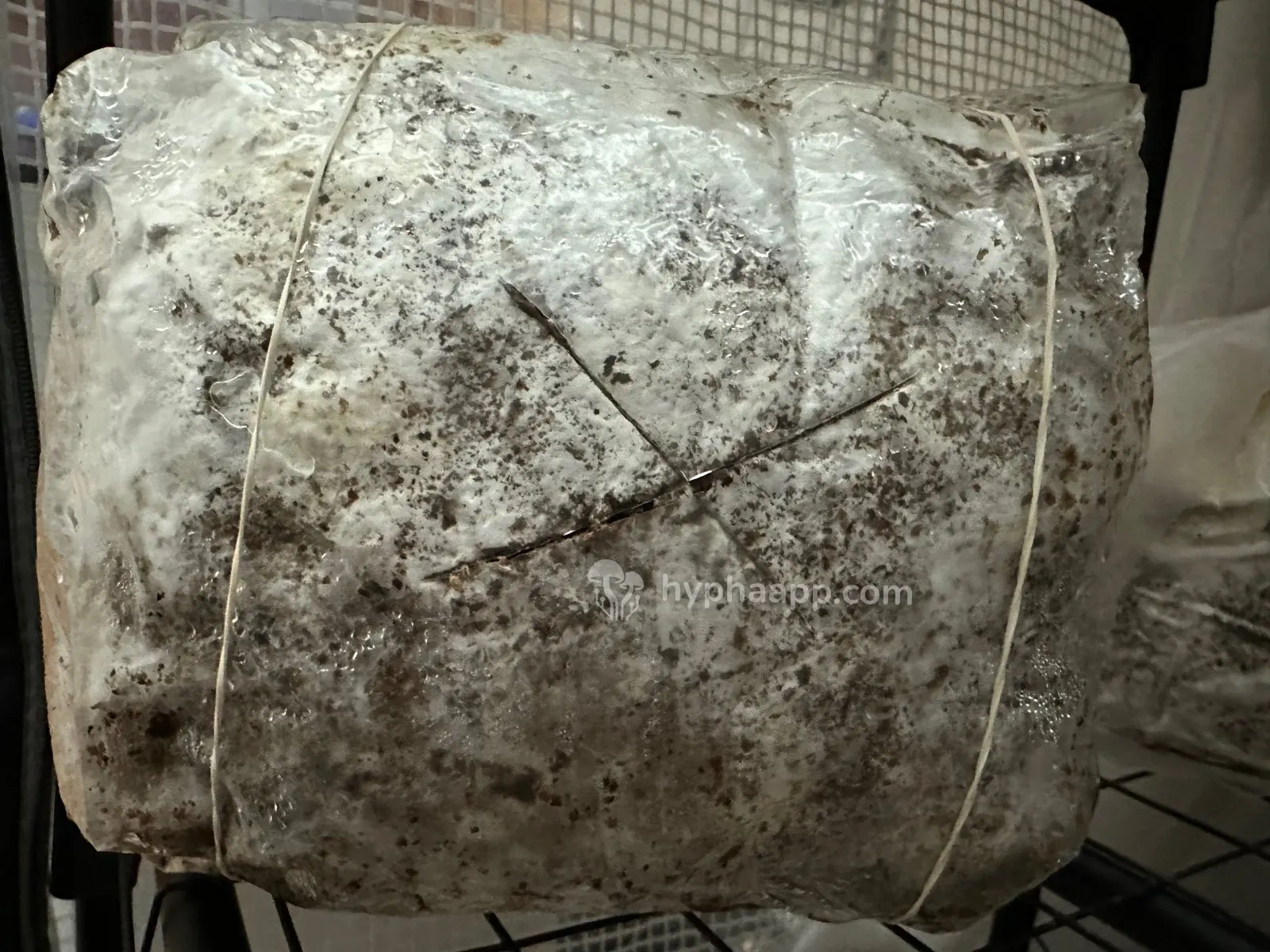
What's it really like to grow on coffee grounds at home?
Small crops, a short clock and a fly risk. Here's what the sources give on each:
- Yield. The SARE farm averaged "around 1 pound of fresh mushrooms per 6 pound bag of medium" (SARE). GroCycle says it has "recycled more than 75,000 kg. of coffee grounds and turned them into more than 20 tonnes of mushrooms" (GroCycle), roughly a quarter of the grounds' weight (our arithmetic). So a 1 kg home bag might give a few hundred grams over its flushes (our reading).
- How many crops. GroCycle's coffee kit is worth re-soaking "Once you have had at least 2 crops from it" (GroCycle); more on that in second flushes.
- Flies. Fungus gnat (sciarid) larvae "feed on mycelium", and the adults "can transport pyemotid (pigmy) mites, nematodes, mold spores" (Penn State Extension). The SARE farm found "Insect control is critical to reduce the spread of contamination" (SARE). Keep bags closed while they colonize and spent ones out of the house (our advice).
- Smell. We found no source that describes how a coffee-ground bag should smell. A sour or rotten smell usually means bacteria in any substrate (our reading); see what bacterial contamination looks like.
What do you do with the spent coffee substrate?
Put it on the garden or in the compost, unless it's moldy. GroCycle's rule for its coffee kit: when "no further crops emerge after 4 weeks, then it is time to break up the mixture that is left and add this rich soil amendment to your plants!" (GroCycle). Our spent block guide covers composting, garden beds and when it goes in the trash.
How do you track a coffee-grounds grow in Hypha?
Save each mix as a recipe, then compare the blocks made from it (our advice). In Hypha, tap Prep, then Recipes, then the Add recipe button. Enter a Recipe name that says the mix, such as "Coffee 50, straw 50, spawn 10%", add each ingredient with Add input (each input links to a supply in Inventory), and put your 24-hour rule under Write the steps. When you create a block, pick that mix under Recipe, and write the café and pickup time in the block's Notes.
Log each pick with Harvest Flush and its Fresh weight. If a bag goes green, finish it as Failed and tick Add contaminated flag, so it counts in the strain's Contam %. On Grows, Filters → Recipe shows only the blocks from one mix, so a coffee bag and a straw bag sit side by side.
Hypha doesn't know how old your grounds are or calculate biological efficiency; here's how to work BE out from what it logs. Download Hypha; the free plan holds 25 active blocks.