How to cut a mushroom grow block: where, what shape, how big
Our advice: cut a mushroom grow bag on the side with a sharp, clean blade: an X about 2 in wide for oyster or several about 1 in for lion's mane, flaps left on. Guides split on top vs side and on how many cuts, so this guide shows where they disagree by species and what a trial on cut size found.

Derick5 min read

Cut a mushroom grow bag on the side with a sharp, clean blade: an X about 2 in wide for oyster, several about 1 in for lion's mane, flaps left on; with a kit, follow its sheet first (our advice). North Spore's Spray and Grow box takes one X behind the front panel. King oyster is usually cut on top; shiitake comes out of the bag. Guides disagree on the rest (table), and one bad cut is unlikely to ruin a block (our reading).
Sources: GroCycle, Smallhold, North Spore, Cornell, a University of Arizona-hosted handout and two peer-reviewed studies, all checked 6 November 2026.
How do you cut a mushroom grow bag?
Snug the plastic, cut an X through it, and leave the flaps on.
- Check it's ready. The block should be fully colonized.
- Snug the plastic. On a tied bag, loosen the tie, "Press the air out with your palms" and re-tie (Arizona handout). No tie? "Tightly fold excess plastic back" (North Spore), or band it after cutting (Smallhold). Boxed kits skip this (our advice).
- Cut. Use "a sharp, clean knife" (Smallhold) or scissors (North Spore). Aim for the plastic, don't dig (our advice). On lion's mane, don't cut over pins under the plastic.
- Leave the flaps. They "help to keep moisture in" (North Spore). GroCycle says to "pull down the flaps" instead.
- Mist the cut. Our kit routine covers how often.
Where do you cut a mushroom grow bag: top or side?
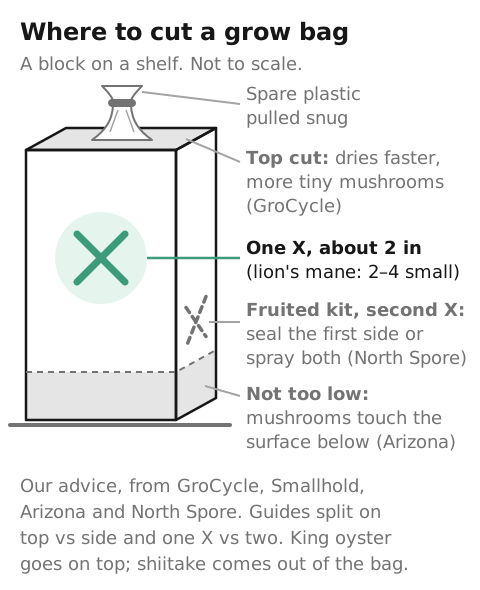
Cut the side (any upright face) unless your species or supplier's sheet says top (our advice); we found no trial testing a side X against a top X.

- Side: With a top cut, "the substrate tends to dry out quicker and you will usually get lots of tiny mushrooms" (GroCycle).
- Top: North Spore's booklet cuts blue oyster "across entire top" and says it can also be side fruited.
- Either: Cornell lays cut oyster bags "so the fruiting is on top or the fruiting can happen on the side", so part of this split is how the block sits (our reading).
- Lion's mane: Cornell warns that top fruiting "can gather water and encourage disease".
- Not low: "Avoid slicing too close to the bottom", or mushrooms "will touch surface below the bag" (Arizona handout).
How big should the cut be?
Go about 2 in for oyster and about 1 in for lion's mane, as Smallhold does (our advice), though guides range from 1 in to the entire top.
For lion's mane, North Spore's booklet says "small holes in the plastic" encourage "even growth".
Does a bigger cut give you more mushrooms?
A bigger cut gave heavier clusters but not clearly a bigger harvest, in the one trial we found comparing 2–6 inch cuts on oyster bags.
Bandura et al. 2021 used 27 lb commercial Pleurotus ostreatus bags set flat, upright or slanted, first flush only. Total cut length matched (our arithmetic): 12 cuts of 50 mm (2 in), six of 100 mm or four of 150 mm (6 in).
Clusters weighed 404–455 g from 50 mm and 585–703 g from 150 mm, in general "significantly higher". On biological efficiency, the overall analysis "did not indicate differences between treatments", though efficiency "improved" with cut size in flat and upright bags, not slanted ones.
The trial doesn't cover other species, a 5 lb block, or later flushes. The authors favored 50 mm for "clusters best suited for packaging and storage", not yield. Our reading: bigger cuts also meant fewer cuts, so size alone may not explain the heavier clusters; stay near 2 in.
How many cuts does a grow bag need?
One X on a boxed kit or small bag, up to three on a 5 lb block (our advice); guides give lion's mane bags two to four small X's.
GroCycle says "For most bags, one hole is enough" and, for "really large bags", one "per 1.6 pounds": about three on 5 lb (our arithmetic).
A king oyster bud-thinning trial reports lower yield from two small holes in the bag's end than one, but only opening the top beat conventional management significantly, 413 vs 302 g per bag (Liu et al. 2022).
Lion's mane "can form to fistsize", so "give adequate spacing between cuts" (Cornell).
What shape should the cut be?
An X is the common choice, and we found no trial testing an X against another cut. One king oyster trial tried round and triangular holes (Liu et al. 2022) but didn't settle shape (our reading).
What do the guides say for each species?
They disagree on placement, size and count.
| Species | Source | Where | Cut |
|---|---|---|---|
| Oyster | GroCycle | Side | Cross, 2 in; one per 1.6 lb |
| Oyster; lion's mane | Smallhold | Two sides | Two X's: 2×2 in; 1×1 in |
| Oyster | Arizona handout | Not low | 5–8 stabs; bag size unstated |
| Blue oyster | Booklet | Top or side | Slice or X across entire top |
| Boxed kit | North Spore | Box opening | One X; size not given |
| Lion's mane | Cornell | Side | Three small V's or X's |
| Lion's mane | Booklet | Top or side | 3–4 small X's |
| King oyster | Cornell; booklet | Top | Cornell: open top, 3 in plastic left. Booklet: small cut, top off after pins, 4 in |
| Shiitake | Booklet | No cut | Block out of bag |
Species steps: oyster, lion's mane, king oyster.
How do you compare two cuts in Hypha?
You compare two cuts in Hypha with one tagged block per cut, reading the weights yourself (we found no side-vs-top trial). Open each block, tap Tag and name its cut, such as "side-2in". On the timeline, tap Put into Fruiting Conditions when you cut and log each pick's weight with Harvest Flush. Above the timeline, Add your photo, then the camera icon, adds photos (app only). Search blocks... finds a tag. Hypha has no metric by tag. Download Hypha; the free plan holds 25 active blocks.
FAQ
When should you cut a mushroom grow bag?
Cut at "full colonization" (Cornell); a ready-to-fruit kit already is. Oyster goes "bright white" (GroCycle), lion's mane "very light", and shiitake brown.
Can you ruin a block by cutting it wrong?
One bad cut is unlikely to ruin a block (our reading). A nick is fine: "It's ok if you cut into the substrate a bit" (Smallhold). Too wide or misplaced? Leave it, keep misting and tape any cut you want closed (our advice). A second X on a fruited kit means sealing the first side or spraying both (North Spore). See side pins.