Best mushroom growing kit for beginners: how to pick one and grow your first flush
The best mushroom growing kit for beginners is a ready-to-fruit oyster kit, which usually gives a first harvest within about two weeks. This guide compares kit types, matches a species to your room, and walks you through the first two weeks stage by stage, with sourced yields and fixes.
Derick9 min read

The best mushroom growing kit for beginners is a ready-to-fruit oyster kit. It arrives already colonized, so you only cut it open, mist it and pick. Most give a first harvest within about two weeks, and some take up to four. Choose blue oyster for a cool room and pink oyster for a warm one (temperature guide).
Key takeaways
- The University of Vermont calls oyster "the most reliable variety for first-time growers".
- Expect pins in about a week. North Spore guarantees its kits will fruit within two weeks.
- Mist the cut two or three times a day. Dry air is the usual reason pins stall.
- Pick oysters before the caps flatten, while the edge still curls under.
We checked every source on 24 October 2026 and label our own advice. We've grown North Spore's Spray & Grow kits and fruiting blocks, and link three of its products below.
What is a mushroom growing kit?
A mushroom growing kit is a bag of sawdust, often mixed with grain, that mushroom mycelium has already grown through, ready to fruit once you open it. The University of Vermont says most hold "a mix of sawdust and grain, wrapped in plastic" (UVM Extension).
The supplier does the hard part, which Cornell says needs "a lab-like setting for inoculations" (Cornell). Your job is fruiting: moist air, fresh air, indirect light and picking on time.
Which kind of mushroom kit should a beginner buy?
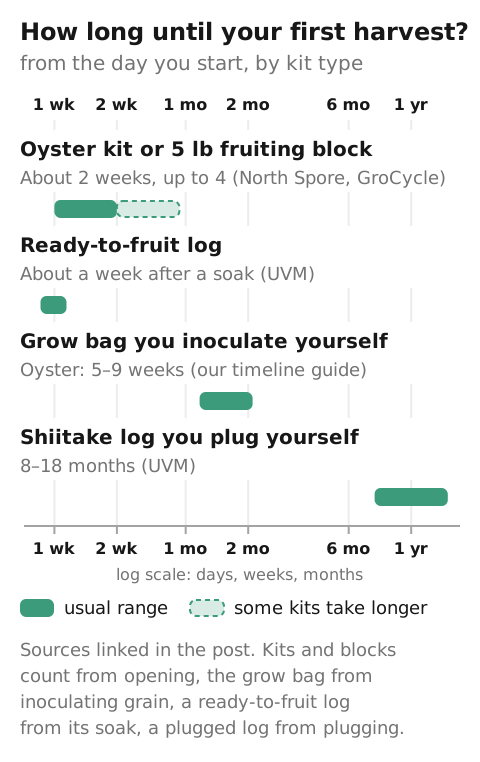
A beginner should buy a boxed, ready-to-fruit oyster kit, because it needs no equipment and often fruits in about two weeks. North Spore's blue oyster kit needs nothing beyond misting (North Spore — affiliate link: we may earn a commission at no extra cost to you).
| Kit type | First harvest | Your work | Usually fails when |
|---|---|---|---|
| Boxed oyster kit | About 2 weeks, up to 4 | Mist 2–3 times a day | The air is too dry |
| 5 lb fruiting block | As little as 7 days | Mist, best in a tent | It dries out |
| Ready-to-fruit log | About a week after a soak | A soak per flush | It dries out |
| Shiitake log you plug yourself | 8–18 months | Shade, water in dry spells | It dries out |
| Grow bag you inoculate | About 5–9 weeks (oyster) | Sterile work first | It gets contaminated |
Boxed kits grow in "1 to 4 weeks", depending on variety and temperature (GroCycle). Don't start one if you'll be away in the next two weeks, GroCycle says, "even if it's only for a day or two" (GroCycle).
Logs suit patient growers with shade. A plugged shiitake log waits "about one year before fruiting" (8 to 18 months), then fruits for three to four years. With a ready-to-fruit log, you "soak it, and get mushrooms a week later" (UVM Extension).
Bags you inoculate aren't ready to fruit. Cornell calls grain "not a beginner substrate" because it contaminates easily (Cornell).
Which mushroom is easiest to grow from a kit?
Oyster is the easiest mushroom to grow from a kit. The University of Vermont calls oysters "the most reliable variety for first-time growers", tolerant of "the drier air often found in homes heated by wood stoves" (UVM Extension).
Lion's mane makes a good second kit. UVM says lion's mane and shiitake kits "can take longer to mature" (UVM Extension). Lion's mane yellows when "too wet or too dry" (North Spore help center); our lion's mane problems guide covers yellow, pink and brown fruit. North Spore's boxed lion's mane kit comes with a spray bottle for daily misting (North Spore — affiliate link: we may earn a commission at no extra cost to you).
How do you set up a mushroom grow kit?
Setting up a mushroom grow kit takes minutes: cut the bag, mist the cut, and place the kit somewhere humid and out of direct sun. For North Spore's boxed kits:
- Start it soon after it arrives. North Spore says "the sooner you start or activate your kit the better". If you must wait, a kit keeps "for around 4 weeks" somewhere cool or in the fridge (North Spore help center). Keep pink oyster out of the fridge, above 60°F (North Spore instructions). If the block broke apart in transit, "Gently press it together" and wait a few days (North Spore instructions).
- Open the front along the perforated line and slice an X in the plastic (North Spore instructions). Leave the flaps on to "keep moisture in" (North Spore help center).
- Mist the cut with the kit's sprayer.
- Place it "in the most humid part of your home and outside of direct sunlight", like a counter near the sink (North Spore instructions). Keep it away from radiators (GroCycle) and out of closets (North Spore help center).
One kit needs no grow tent. In a dry or air-conditioned home, drape a bag with "1/2 inch holes" over it, mist inside the bag daily, and remove it once pins form (North Spore help center). People with allergies may want kits "outdoors or in a well-ventilated area" because of spores (North Spore instructions).
What happens in a mushroom kit's first two weeks?
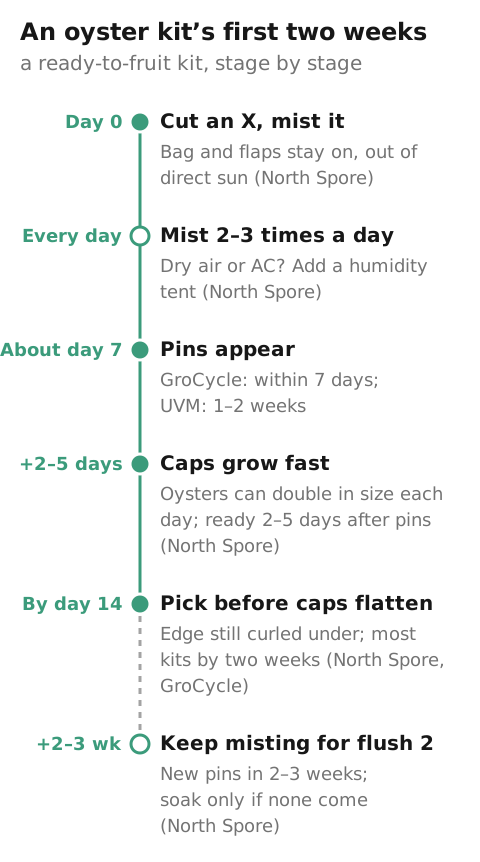
A mushroom kit's first two weeks run from misting a bare cut to your first harvest, with pins in about a week. A kit arrives colonized, near the end of the stages of mushroom growth.
- Days 0–7: mist and wait. Mist 2–3 times a day, "a little extra" in a dry climate (North Spore help center). Spray finely "from at least 30cm away" (GroCycle).
- About day 7: pins. GroCycle expects oyster pins within 7 days of opening a kit (GroCycle), and UVM within one to two weeks (UVM Extension). Keep misting so pins don't dry out (North Spore help center), but not straight onto the caps (GroCycle).
- 2–5 days later: harvest. Mushrooms "should be ready 2-5 days after pin formation" (North Spore instructions). Oysters "double in size each day" (North Spore help center). Pick "right before their caps begin to flatten out, while the edge is still a little curved under" (North Spore help center). Twist off the whole cluster, and cook it thoroughly (North Spore help center).
- Day 14: nothing yet? North Spore's kits "will fruit within two weeks, or we'll send you a replacement" (North Spore help center). First run our kit checklist.
What goes wrong with a mushroom kit, and how do you fix it?
Most mushroom kit problems come from dry air, too little fresh air or light, or contamination, and each has a visible sign.
| What you see | Likely cause | Read more |
|---|---|---|
| No pins after two weeks | Dry block, cold room or dark spot | Symptom table |
| Pins form, then shrivel | Too little humidity | Stalled pins |
| Long stems, tiny caps | Too little fresh air or light | CO2 guide |
| White fuzz at the stem base | Too much CO2 or moisture | Look-alikes |
| Pale caps | Too little light | Light |
| Yellow cap edges | Drying out, or mist on the caps | GroCycle |
| Amber droplets on the block | Exudate, which is normal | Yellow liquid |
| Green, black or orange patches | Mold | Kit spots |
The causes come from North Spore's booklet and its help pages on odd growth, mold and amber beads, and from GroCycle.
How much will a beginner mushroom kit produce?
A beginner mushroom kit produces from a few ounces to about 2 pounds on its first flush, and less after. North Spore says an oyster kit's first flush "could produce anywhere between ½-2 lbs" (North Spore help center).
In a 2022 home test, Consumer Reports weighed 147 grams (about a third of a pound), then 90.7 grams, from a North Spore blue oyster kit (Consumer Reports). That's about half a pound from two flushes.
A kit costs more per pound than shop mushrooms. North Spore's blue oyster kit cost $34.99 on 24 October. By our arithmetic, that's about $70 a pound if it yields half a pound, or $17.50 if it yields 2 pounds. US oyster growers got an average $3.43 a pound at first sale in 2025–26, before any store markup (USDA NASS). You're paying to learn.

What do you do after the first flush?
After the first flush, keep misting the kit where it sits. North Spore expects new pins in about 2–3 weeks (North Spore instructions). Don't cut a second X (North Spore help center).
If no pins appear by then, soak: "Most species only need to soak for 20 minutes", and lion's mane only 5–10 minutes (North Spore instructions). Our second-flush guide compares soak times.
Expect two or three flushes in total (GroCycle), then see when a block is done. A spent kit goes "to your compost pile or directly to your garden beds" (UVM Extension).
When should you move beyond kits?
Move beyond kits when you want more mushrooms per dollar, and the usual next step is a bagged 5 lb fruiting block. North Spore says its blocks "can produce more mushrooms" than its kits, can fruit "in as little as seven days", and do best in a chamber like a Martha tent (North Spore — affiliate link: we may earn a commission at no extra cost to you).
Our Martha tent guide covers setup, and our cost guide prices the blocks. Next, make your own blocks from grain spawn or a liquid culture syringe.

How do you keep track of your mushroom kits?
Keeping track of a mushroom kit means noting the day you cut it open and each flush's date and weight. A notebook works for one kit (what to record).
In Hypha, our grow tracking app, add the kit as a bulk block and pick its strain. The day you cut it, tap Put into Fruiting Conditions. Hypha sets a first-flush reminder 10 days out, and each logged flush sets the next one 10 days later. Tap a reminder on the timeline to move it, say to North Spore's 2–3 weeks for new pins. Log each flush's date, fresh weight and notes.
Hypha has no soak step or pin-date field, won't tell you when a kit is spent, and shows reminders in the app, not as phone notifications. Download Hypha; the free plan holds 25 active blocks.
FAQ
Do mushroom growing kits really work?
Mushroom growing kits work when they arrive colonized and get misted two or three times a day. When a colonized kit won't pin, North Spore's first guess is that "it might be dry" (North Spore help center).
Can you make new blocks from a used kit?
A used kit is for more flushes, not new blocks. A block opened on a counter isn't clean enough for sterile work (our advice). Start new blocks from grain spawn.
Can I use tap water to mist a mushroom kit?
Tap water is fine for a mushroom kit wherever it's safe to drink, North Spore says. If you'd rather avoid chlorine, leave the water out for 24 hours first (North Spore help center).