How to get a second flush of mushrooms: rest, soak and flush counts by species
To get a second flush of mushrooms, rest the block one to two weeks in fruiting conditions. Soak oyster and lion's mane only if they dry out, and rest shiitake longer, then soak it after every harvest. This guide gives rest, soak and flush counts by species, explains why later flushes shrink, and shows when a block is done.

Derick9 min read

To get a second flush of mushrooms, rest the block one to two weeks in fruiting conditions after you harvest. Soak an oyster or lion's mane block only if it has dried out, for minutes to a day. Shiitake is the exception: our sources rest it 8 days to 4 weeks, then soak it 12 to 48 hours. Expect two or three flushes from most blocks, each usually smaller than the last.
Our sources are extension guides from Cornell, the University of Vermont and Mississippi State, a SARE farm method and a 2020 oyster study. Kit sellers fill in the details. We checked them on 24 October 2026 and label our own methods.
How long between flushes of mushrooms?
The wait between flushes is usually one to three weeks, and each later flush can take a little longer. Smallhold says a block needs "usually around a week after harvest" to recover (Smallhold). GroCycle's oyster kit regrows "in around 7-14 days, but can occasionally take up to 21 days" (GroCycle). Our timeline guide lists the gap between flushes by species.
Keep the block in fruiting conditions while it rests. For a Martha tent or automated chamber, North Spore says to "Leave humidity and fan running and wait about 2 weeks" (North Spore — affiliate link: we may earn a commission at no extra cost to you). The University of Vermont differs: it rests a kit "about a week in a cool, dry place", then soaks it again (UVM Extension). Heated winter rooms dry blocks out, so watch for signs of too little humidity.
One block of ours, not a rule for its species: we harvested a king trumpet (king oyster) block's first flush on 9 April 2026. Our timelapse camera first caught it about five days later, already covered in pins. We picked its second flush on 19 April, about 10 days after the first.

Do you need to soak a block for a second flush?
Oyster and lion's mane blocks need a soak only if they dry out; FreshCap says fruiting conditions alone bring a new flush (FreshCap). Shiitake blocks get a soak after each flush.
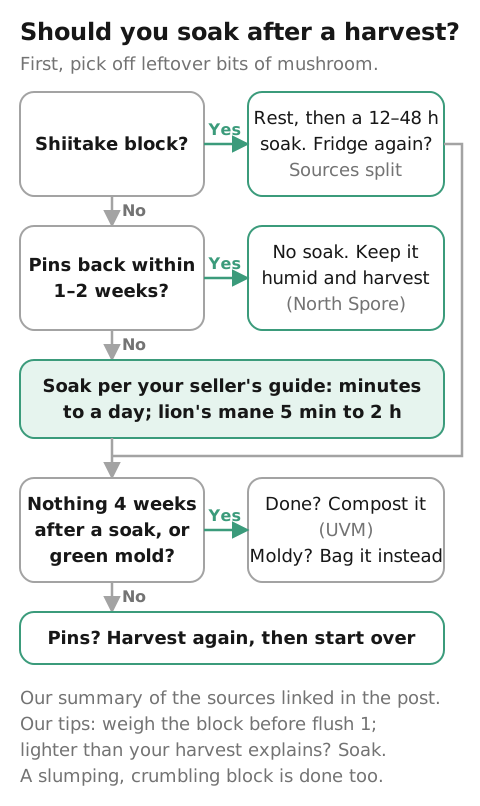
First, pick off leftover mushroom bits. North Spore's booklet says clearing the block down to the sawdust helps "prevent rotting and possible contamination" (North Spore booklet).
For its boxed oyster kit, North Spore keeps spraying and soaks only if no pins form "after a week or so" (North Spore help center). GroCycle's blue oyster guide skips the soak if you "keep moisture levels and humidity high" (GroCycle). Other kits soak every time: GroCycle's oyster kit rests two days, then soaks overnight (GroCycle).
Our weigh test is a method, not a measured result. Weigh the block when it goes into fruiting and after each harvest. GroCycle notes a kit "gets lighter and shrinks" as it crops (GroCycle). If it's much lighter than the mushrooms you picked can explain, soak it. Once drained, it should be back toward its starting weight.
After a soak, North Spore drains the block cut side down for 10 minutes to avoid "standing water in your bag" (North Spore help center). Caps that stay wet invite blotch. If pins formed and then dried off, use our stalled-pin reset.
Why does every guide give a different soak time?
Soak times differ because a boxed kit, a 5 lb block and a shiitake block take up water differently.
- Product form. By our reading, a boxed kit's bag is its humidity tent; a 5 lb block's bag sits in a humid chamber.
- Block size and texture. A bigger, denser block likely takes longer to wet through. Lion's mane can break apart if "left to soak for too long" (North Spore booklet).
- Species. Shiitake is soaked as a shock. Cornell says shocking is "not typically used with any other species of mushroom" (Cornell).
The documented range is wide:
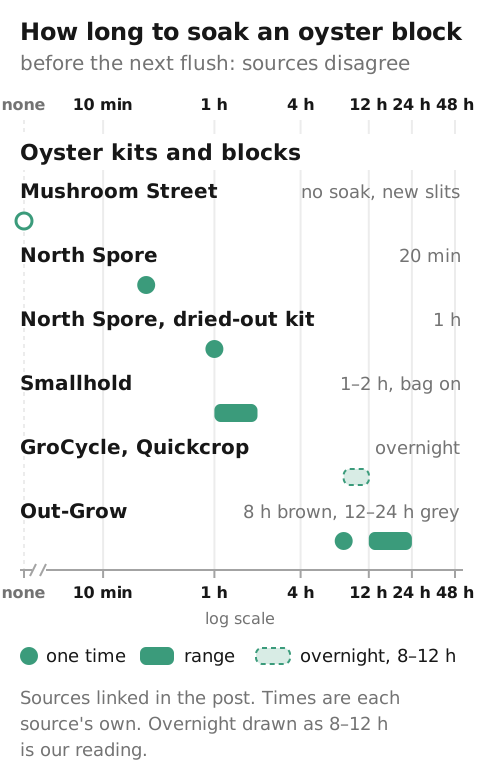
- Oyster: new slits and no soak for flush 2 (Mushroom Street Farms), 1–2 hours (Smallhold), or about 20 minutes (North Spore booklet). A dried-out kit gets an hour (North Spore help center). Quickcrop's kit gets overnight (Quickcrop). Out-Grow's brown oyster kit, sold on Foraged, gets eight hours (Foraged) and its grey oyster 12–24 hours (Out-Grow).
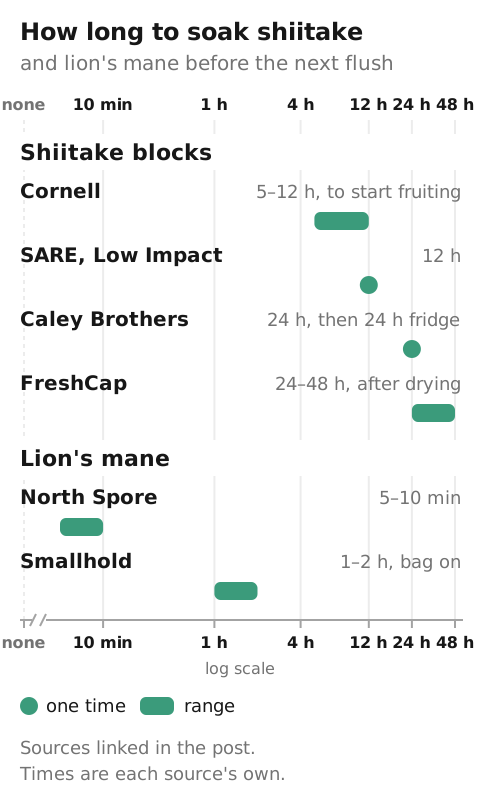
- Lion's mane: 5–10 minutes (North Spore help center), or 1–2 hours "with the bag still on" (Smallhold).
- Shiitake block: 12 hours (SARE, Low Impact), 24 hours plus 24 in the fridge (Caley Brothers), or 24–48 hours (FreshCap). Cornell's shock to start fruiting is 5–12 hours (Cornell); using it between flushes is our reading.
Shiitake guides split on the rest, too. Low Impact dries the block 3–4 weeks in good airflow so the outside isn't "going mouldy" (Low Impact). SARE rests it 8–12 days, "depending on the moisture content" (SARE).
Second flush by species: what do the sources say?
Second-flush advice mostly agrees on flush counts, two or three for most blocks, and splits most on soak time. A dash means no figure.
| Species and format | Rest | Soak | Flushes to expect | Source |
|---|---|---|---|---|
| Oyster, boxed kit | 2 days; pins 7–14 days after the soak | Overnight | Usually 2–3 | GroCycle, buyer's guide |
| Blue oyster, 5 lb block | About 2 weeks | About 20 minutes, if no pins | 2–3 | North Spore booklet, North Spore FAQ — affiliate link: we may earn a commission at no extra cost to you |
| Pink oyster bag | Next flush in about 7 days | — | 2–3, one of the easier oysters to re-flush | GroCycle |
| Grey oyster block | 5–10 days | 12–24 hours | Typically 2–3 | Out-Grow |
| Lion's mane kit or block | About a week | 5 minutes to 2 hours | Up to 2 | Smallhold, blog, North Spore help center |
| Black king (oyster × king trumpet hybrid) block | About 1 week | 20 minutes, cold | 1–2, "somewhat difficult" | North Spore booklet, Black King guide |
| Shiitake block | 8–12 days | 12 hours | Typically 2 | SARE |
| Shiitake block, dried | 2–3 weeks or more | 24–48 hours | Re-soak 2–3 times | FreshCap |
Why is the second flush smaller?
The second flush is usually smaller because the first used up much of the block's water and nutrients. GroCycle says each crop gets smaller "as more nutrients and water are extracted from the kit" (GroCycle). The University of Vermont says that in most cases, later batches "take longer to grow and have a smaller yield" (UVM Extension).
A 2020 study grew oyster mushrooms on six substrates, and yield fell with each of three flushes on every one. The cotton-husk control gave 302.5 g, then 232 g, then 147.6 g (AMB Express).
Shiitake has an outlier: FreshCap says a dried block's second flush "can sometimes be even larger than the first!" (FreshCap).

Logs are not blocks. For shiitake logs, Mississippi State says "The second and third mushroom flushes are the most productive" (MSU Extension). On blocks, later flushes usually shrink.
How many flushes can you get from a block?
Most gourmet blocks give two or three flushes, and king trumpet often gives one or two. North Spore's booklet expects 2–3 flushes from blue oyster, 2 from lion's mane, 1–2 from king trumpet and 2–4 from shiitake (North Spore booklet).
Smallhold says its royal trumpets (king trumpet) are "trickier" to refruit because they grow from the block's top "rather than a cut site" (Smallhold). Our timelapse block's quick second flush is one example, not a promise.
A third flush is a bonus, not a given. North Spore guarantees a kit's first flush and says you can "often get a second, third, maybe even fourth" (North Spore help center). Farms in a SARE study mostly rotate blocks out after 2–4 weeks of fruiting.
How do you know when a block is done?
A block is done when a re-soak brings nothing for about four weeks, or when mold appears. GroCycle re-soaks after two crops, and if "no further crops emerge after 4 weeks", breaks it up (GroCycle).
Blocks may grow more prone to mold with each flush, Smallhold warns (Smallhold). On shiitake, FreshCap and Caley Brothers stop at green mold (FreshCap, Caley Brothers). Learn to spot green mold in our contamination guide.
Two more signs are our own rules of thumb: a block that slumps or crumbles, and one whose last flush was a small share of its first.
What do you do with a spent mushroom block?
A spent block belongs in the compost or a garden bed. The University of Vermont says to add it "to your compost pile or directly to your garden beds" (UVM Extension).
Warmth matters outdoors: pink oysters "won't fruit outside unless temperatures are above 70 degrees" Fahrenheit, about 21°C (North Spore — affiliate link: we may earn a commission at no extra cost to you). In a winter garden, we'd expect nothing before the next warm season. Bag a green-mold block where it sits instead (contamination guide).
What should you write down between flushes?
A second-flush log needs each flush's date and weight, and any soak, to show which blocks earn another flush. Note each harvest's fresh weight, the block's weight before and after a soak, the soak length, and when pins returned (full field list).
In Hypha, log each flush's date, fresh weight, dry weight and notes, including the soak. Logging a flush sets the next-flush reminder 10 days after that harvest, the same default for every species. Tap it on the block's timeline to change the date. Reminders show there and in the Schedule tab, not as phone notifications.
Finish a block and its Grow Summary shows the days, total harvest and flush count. Hypha has no soak step and won't tell you when a block is spent. Download Hypha; the free plan holds 25 active blocks, and each counts until you archive it.
FAQ
Can I cut a new X for the second flush?
A new cut isn't needed for a second flush. North Spore says there's no need to "cut a second X in it" (North Spore help center). Cornell says oyster bags fruit again "from the same cut" (Cornell). A second X can dry the block, and each side's fruit "might be smaller" (North Spore help center).
Should the bag stay on during the soak?
The bag stays on for most kits, but sources split on 5 lb blocks. Smallhold and Quickcrop soak their small kits with the bag on (Smallhold, Quickcrop). For 5 lb blocks, North Spore's booklet keeps the bag on (North Spore booklet). North Spore's FAQ says "Remove the block from the bag" (North Spore — affiliate link: we may earn a commission at no extra cost to you).
Should I put a shiitake block in the fridge again?
Sources split on giving a shiitake block a second fridge shock. Caley Brothers soaks 24 hours, then refrigerates 24 (Caley Brothers). FreshCap calls a second cold shock "usually counterproductive" (FreshCap), and Low Impact skips it too (Low Impact).