How to make grain spawn at home: grain prep, jars or bags, and pressure-cooking times
Make grain spawn by soaking and simmering whole grain, drying it, and pressure-cooking it in jars or filter-patch bags at 15 PSI. Then inoculate it from liquid culture or agar. This guide covers which grain to use, cook times by container and altitude, and what goes wrong.

Derick9 min read

Make grain spawn by soaking whole grain for 12–24 hours, simmering it for 10–20 minutes and letting the outside dry. Fill jars or filter-patch bags and pressure-cook them at 15 PSI: 90 minutes for quart jars, longer for bags and at altitude. Cool them overnight, then inoculate from liquid culture or agar in still air. Most jars colonize in 2–3 weeks. This guide is for gourmet species.
Our sources are GroCycle, the UF/IFAS, UC, Penn State and Utah State extensions, Cornell Small Farms, Presto, Low Impact, La Mycosphère, Unicorn Bags, North Spore's help center and two grain sellers, Out-Grow and Rootlab, all checked 1 November 2026.
What do you need to make grain spawn at home?
You need whole grain, jars or filter-patch bags, a pressure cooker that holds 15 PSI, and a clean culture, plus 70% alcohol and gloves (GroCycle).
| Item | What it's for |
|---|---|
| Bucket, pot, baking tray | Soaking, simmering, drying |
| Quart jars with filter lids, or filter-patch bags | Holding the grain |
| Pressure cooker with a rack, and foil | Sterilizing at 15 PSI |
| Autoclave tape and a marker | Labels that survive the cooker |
| Still air box or flow hood | Inoculating in still air |
Is it worth making? Cornell Small Farms warns that "it is very easy to get contamination on grain, so this is not a beginner substrate", and says most growers buy spawn (Cornell). Buying colonized grain spawn skips this step, as we have for blue oyster (North Spore — affiliate link: we may earn a commission at no extra cost to you).
Which grain is best for grain spawn?
The best grain for grain spawn is whichever whole grain you can get reliably; UF/IFAS says the choice "depends on availability, cost, and preference" (UF/IFAS). GroCycle compares the common ones (GroCycle):
| Grain | GroCycle's take |
|---|---|
| Rye | "Holds more water than most other grains", but "often challenging to find" |
| Wheat | "Does not hold as much water and can dry out if not well-soaked" |
| Millet | Small kernels give "more inoculation points"; mushy if over-soaked |
| Sorghum | "Commonly used by commercial growers"; "less prone to contamination than rye or wheat" |
| Brown rice | "Mushy or sticky" and "more prone to contamination" |
| Barley | "Can get very mushy" |
For oyster, UF/IFAS calls millet "an excellent substrate". Rootlab, which sells grain bags, adds whole oats as "a popular choice" (Rootlab).
How do you prepare grain for mushroom spawn?
You prepare grain for mushroom spawn by soaking, simmering and surface-drying it until each kernel is plump but not mushy. Steps follow GroCycle unless noted.
- Measure. Grain swells "2 to 3 times in volume"; GroCycle's rule of thumb is dry grain at about ⅓ of the final volume you want.
- Soak for 12–24 hours, no longer, or it sprouts; UF/IFAS soaks millet about 12 hours, as longer soaking ferments it (UF/IFAS). UC cooks jars twice, 24 hours apart, so heat-resistant bacterial spores germinate in the gap and die in the second run (UC). By our reading, a soak does that job before a single cook (pink oyster FAQ).
- Simmer for 10–20 minutes, stopping before kernels crack open.
- Drain and dry on a baking tray for "an hour or two".
- Squish test. A kernel should crush "with some pressure, but it shouldn't be mushy". Hard kernels need more soaking; mushy ones mean starting over, as over-wet grain "slows colonization and increases chances of contamination". See also too wet or too dry.
Jars or bags: which should you use for grain spawn?
Use quart jars for small, reusable batches and filter-patch bags for more grain per run. Our advice: jars are easier to inspect, bags scale better (buyer's guide).
Jars can be cleaned and reused, "causing less plastic waste than single-use bags", GroCycle says. Fill to 1–2 inches below the rim so you can shake them. GroCycle's homemade lid has a ¼-inch hole stuffed with polyfill as a filter and an ⅛-inch hole sealed with silicone as an injection port (GroCycle).
Bags get filled to "a maximum of 1-2 inches (2-5 cm) below the filter patch", Low Impact says, so the filter stays clear and there's air to shake (Low Impact). They close with a heat seal; Unicorn's 5-micron Type B bags "can be sealed before autoclaving" (Unicorn Bags).

How long do you pressure cook grain spawn?
Pressure cook quart jars of grain spawn for 90 minutes at 15 PSI, timed from when the cooker reaches pressure, and bags for 2–3 hours. GroCycle's step-by-step gives 90 minutes, though the same page elsewhere says "around 2 hours" (GroCycle). Grain needs sterilizing.
| Load | Time at 15 PSI | Source |
|---|---|---|
| Quart jars | 90 min | GroCycle |
| Quart jars, autoclave | 45 min, then 45 min 24 h later | UC |
| Several small bags | 2 h or more | Low Impact |
| Cooker full of large bags | 3 h | Low Impact |
| 1-lb rye bag, commercial | 3 h | Out-Grow |
Bag centers heat slowly, Low Impact says, and no home-cooker source we found gives a time for 3- or 5-lb bags.
Load it. Cover each lid with foil "to prevent water from getting in through the filter hole", and stand the jars on a rack, not touching each other or the sides (GroCycle). Add water as your cooker's manual says, and check that quarts fit under its lid (cooker sizes).
Time it. At 15 PSI near sea level, a cooker reaches 250°F (121°C). On a Presto without a gauge, "once the pressure regulator begins to rock, cooking time begins" (Presto).
Cool it. Presto lets the pressure on grains "drop of its own accord"; that's about food, but by our reading it suits jars too. GroCycle leaves jars in the cooker "8 hours or overnight". UF/IFAS then shakes them: the bottom is "where moisture collects during cooling" (UF/IFAS).
Test the cook. Our advice: leave a jar uninoculated for a week or two; if anything grows, the cook or seal failed. It's adapted from a broth-jar test (La Mycosphère).
How do you adjust pressure-cooking time for altitude?
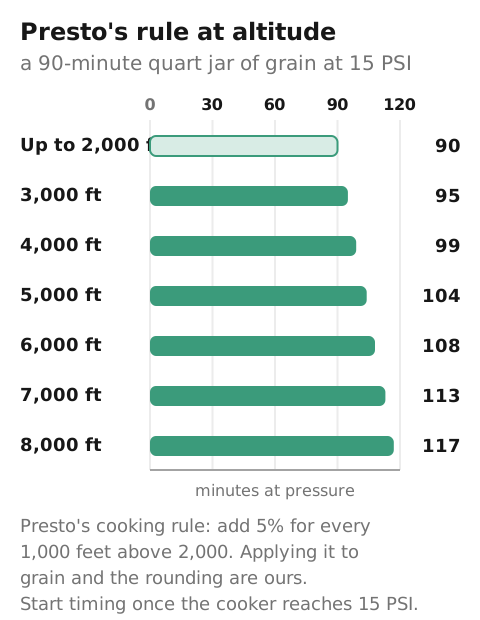
Presto's manual adds 5% to cooking time for every 1,000 feet above 2,000, plus ½ cup of water from 3,000 feet (Presto). It's a food rule; using it for spawn is our reading. For a 90-minute jar, it gives about 95 minutes at 3,000 feet, 104 at 5,000, 113 at 7,000 and 117 at 8,000 (our arithmetic, rounded up).
Water boils about 2°F lower for every 1,000 feet, so food doesn't get as hot inside (Utah State University Extension). Canning tables add pressure instead, but stop at 15 pounds (Penn State Extension, Utah State). Spawn already runs at 15 PSI, so by our reading time is the only lever left. Our advice: never run a cooker above its rated pressure.
How do you inoculate grain from liquid culture or agar?
Inoculate cooled grain with 1–2 mL of liquid culture per quart jar through the injection port, or with a piece of colonized agar in still air. For bags, GroCycle's rule is 1–2 mL per pound of grain, so 5–10 mL for a 5-lb bag (GroCycle). More isn't faster: Rootlab says extra liquid will "sit at the bottom of the bag and create a microclimate in which bacteria thrive" (Rootlab).
Agar means opening the jar, so GroCycle works at a flow hood or in a still air box. UF/IFAS uses a full 60 mm plate, or a quarter of a 100 mm plate, per 400–450 g of grain (UF/IFAS). Ready plates exist for species such as lion's mane (North Spore — affiliate link: we may earn a commission at no extra cost to you).
Step-by-step injection: our liquid culture syringe guide. Expanding one jar: grain-to-grain transfers.
How long does grain spawn take to colonize?
Grain spawn takes about 2–3 weeks to colonize, depending on species, grain and conditions (GroCycle); UF/IFAS gives oyster 10–20 days at 73°F (23°C) in the dark. GroCycle says some growers break and shake jars "a third of the way colonized", and a jar is ready once "uniformly white". Our pink oyster guide covers readiness and how much to use per block. Pale species fool the eye: lion's mane, pink oyster, hen and chicken of the woods "typically have a faint mycelium and look uncolonized" (North Spore help center). Next, spawn it to bulk (oyster, king oyster).
What goes wrong with homemade grain spawn?
Contamination in homemade grain spawn almost always comes from a short cook, over-wet grain or a dirty inoculation (GroCycle).
| What you see | Likely cause | Next batch |
|---|---|---|
| Wet bottom layer that smells sour | Bacteria (GroCycle, UC) | Full soak, drier grain; bacteria |
| Green patches | Mold, most often Trichoderma | Cook and technique; green mold |
| Split, mushy kernels | Simmered too long | Shorter simmer |
| Hard kernels | Under-soaked | Soak longer |
| No growth after a week | Culture or temperature | Stalled colonization |
| Water in the jar after cooking | No foil over the filter | Foil every lid |
How do you track grain spawn batches in Hypha?
You track grain spawn in Hypha as a recipe, a prep run and its jars. In Hypha, add grain, lids and jars under Prep → Inventory, then build a spawn-stage recipe under Recipes with container Grain Jar. Use Add input to link each supply and set how much one batch uses. Soak and cook times go in Instructions.
On cook day, tap Prep this recipe, set How many batches, enter the Actual outputs per batch and leave Deduct supplies on. The jars land in Inventory as Prepped stock. A spawn block started from that stock carries its Amount in g or oz from the recipe's expected output. Log each Break & Shake, tap Mark Ready, then Start transfer into bulk.
If a jar goes bad, finish it as Failed and tick Add contaminated flag. The strain's Performance card then shows spawn Contam for All time or the Last 90 days. Hypha doesn't record pressure or cook time beyond what you write, and doesn't spot contamination. All of this is on the free plan. Download Hypha.
FAQ
Can you make grain spawn without a pressure cooker?
Not reliably: Penn State says botulism spores survive boiling (212°F) and die at 240°F (Penn State Extension). Cornell rates atmospheric steam, grain included, as "higher contamination than pressurized" (Cornell). Without a cooker, buy pre-sterilized grain bags.
How long does grain spawn last?
Grain spawn lasts about three months in a fridge, North Spore says, but pink oyster "cannot be refrigerated and is best used within one month" (North Spore help center). See also spawn.
How much grain fills a quart jar?
A little under a third of a jar of dry grain, by GroCycle's rule of ⅓ of the final volume, with hydrated grain stopping 1–2 inches below the rim (GroCycle). No source we found gives a weight, so weigh your first batch.