What to do with a spent mushroom block: one more flush, the garden, compost or the trash
A spent mushroom block goes in the compost or a garden bed; a moldy one goes in the trash, bagged. This guide shows how to tell a block is done, how to use it in the garden, and why bagged 'spent mushroom compost' is something else.

Derick5 min read

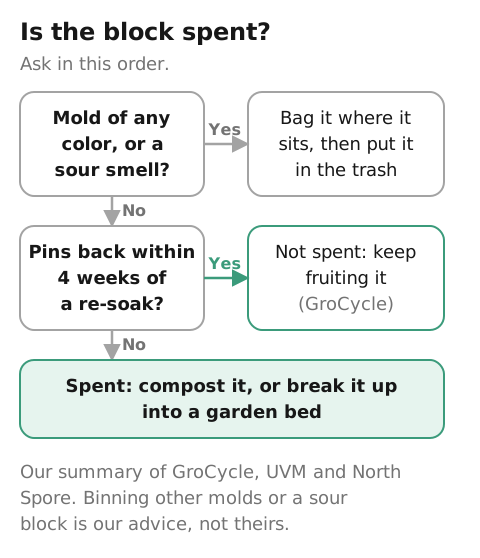
A spent mushroom block goes in the compost pile or straight into a garden bed. It's done when a re-soak brings no mushrooms for about 4 weeks. A block with mold of any color goes in the trash, bagged. Bagged "spent mushroom compost" from a garden center is a different product.
Our sources are extension guides from the University of Vermont and Penn State, GroCycle, Smallhold, the Central Texas Mycological Society, North Spore's help center, Civil Eats and a peer-reviewed study, all checked 1 November 2026.
Is your mushroom block really spent?
A block is spent when a re-soak brings no pins for about 4 weeks, or when mold appears. GroCycle says that after "at least 2 crops" it's "worth trying to re-soak and get another", but if "no further crops emerge after 4 weeks, then it is time to break up the mixture" (GroCycle). That's a care rule for its coffee-ground kit; we apply it to sawdust and straw blocks too (our reading).
North Spore says you can "often get a second, third, maybe even fourth fruiting" (North Spore help center), so see our flush counts by species before giving up. Smallhold warns that blocks "may be more susceptible to pests such as mold during successive grows" (Smallhold). A block that slumps or crumbles is done too, by our own rule of thumb (more signs).
For more mushrooms, start a fresh block: North Spore says its blue oyster block can give a first harvest "in as little as seven days" (North Spore — affiliate link: we may earn a commission at no extra cost to you).
Can you compost a spent mushroom block?
Yes, a spent block composts well. The University of Vermont says to "add the substrate to your compost pile or directly to your garden beds" (UVM Extension), and Smallhold calls spent blocks "a valuable compost additive" (Smallhold).
- Take off the plastic. The Central Texas Mycological Society (CTMS) says to "dispose of plastic bag in the trash" (CTMS). Peel off any filter patch, too (our advice).
- Break it up into "chunks about the size of your fist", not powder (CTMS).
- Add greens. CTMS says blocks are "very high in carbon", and too many without enough nitrogen "will slow decomposition". Mix in coffee grounds or grass clippings.
How do you use a spent mushroom block in the garden?
Break a spent block up and mix it into the soil, or build it into a bed in layers. Smallhold says blocks can be "crumbled up and loosely planted around the base of trees or in your backyard garden" (Smallhold).
CTMS builds a lasagna bed in three 6-inch layers: broken blocks, then "nitrogen-rich material" such as coffee grounds, then compost or topsoil. Each new planting season, it mixes "1–2 crumbled mushroom blocks per 4x4 foot bed" into the top (CTMS).
Mix it in rather than planting straight into pure block, and go light around seedlings and salt-sensitive plants (our advice). In a 2008 study, spent oyster substrate (grown on sunflower-seed hulls) mixed 2:1 soil to substrate still had 3.3 times the electrical conductivity (a salt reading) of plain soil, "high for the growth of most plants", though sage grew about 21% more in it (López Castro et al. 2008). CTMS's bed keeps roots off the blocks at first: you plant "directly into the topsoil layer" on top (CTMS).
Want mushrooms from a bed on purpose? Grow wine cap.
Will a spent block grow mushrooms outdoors?
A spent block sometimes fruits outdoors, but don't count on it. Smallhold says that in the garden "you may eventually see some mushrooms growing" (Smallhold).
CTMS's outdoor advice is for Central Texas, where late fall into spring is "the ideal time for growing mushrooms outdoors" (CTMS). Its tip to set a block outside in its bag, shaded, moist and below 80°F, is for a block still fruiting; CTMS composts it once it's done (CTMS FAQ), so try that before calling a block spent. In a cold northern garden in November, we'd expect nothing before spring (our reading).
When should a spent block go in the trash?
A spent block goes in the trash when it has mold of any color, or smells sour. Our contamination guide tosses green, black or orange spores, following GroCycle and North Spore; tossing other molds and sour blocks is our own advice. For orange bread mold, GroCycle says to "seal the contaminated substrate in a plastic bag and dispose of it immediately" (GroCycle).
Bag it where it sits, mask and gloves on, and don't break it up, so you don't shake spores loose (our advice). Our Martha tent guide shows how. CTMS composts moldy blocks (CTMS FAQ); we keep them sealed and out of the compost (our advice).
Is spent mushroom compost the same as a spent mushroom block?
No: bagged spent mushroom compost is what's left after commercial button mushroom crops, a compost of manure and straw. Penn State's Agaricus guide says "Sometimes this material is called spent mushroom compost" (Penn State Extension).
Civil Eats describes Agaricus as "the common cremini, button, or portobello" and calls its spent substrate "a very different material from specialty mushroom substrate" (Civil Eats). See why button mushrooms need that compost.
Because some plants are sensitive to salt, Penn State's Agaricus guide says to "avoid using fresh spent substrate around those plants" and to use material "weathered for 6 months or longer" (Penn State Extension). That's advice for manure-based compost. We found no extension guidance on weathering sawdust or straw blocks (our reading), so go light around salt-sensitive plants.
How do you close out a spent block in Hypha?
You close out a spent block in Hypha by finishing it and archiving it. In Hypha, tap Finish on the block's timeline and choose Successful if it gave you a harvest, even if mold came later, or Failed if not. Add contaminated flag appears only under Failed: tick it if mold ended the block before any harvest, since Failed alone doesn't count toward contamination rates. Leave Archive block ticked (the default) to hide the block; it's still under Grows → Blocks → Filters → Archived only. The Grow Summary shows its days, total harvest and flush count, so you can work out its BE.
Hypha won't tell you when a block is spent. Download Hypha; the free plan holds 25 active blocks, and a block counts until you archive it.
FAQ
Is spent mushroom compost acidic?
Spent mushroom compost runs from slightly acidic to slightly alkaline. Penn State lists fresh spent substrate at pH 5.8–7.7, and material weathered 16 months averaged 7.1 (Penn State Extension). That's the bagged button mushroom product, not your block.
Can you reuse a spent block to grow more mushrooms?
You can reuse a block for more flushes, but not to make new blocks at home: a used kit opened on a counter isn't clean enough for sterile work (our advice).