How fast do mushrooms grow? We timed one cap against 'doubles every day'
Cultivated mushrooms usually go from pins to full size in about 2 to 10 days. On two caps we measured against 'doubles every day', apparent width grew about three to five times in 24 hours.

Derick5 min read

Cultivated mushrooms usually go from pins to full size in about 2 to 10 days, with oysters and log-grown shiitake toward the fast end (our summary). On the two caps we measured, what looks like a pink oyster, apparent width grew about three to five times in 24 hours, so "doubles every day" looks conservative for that day (our reading), though the pace changes as a cap grows.
Our sources are North Spore, GroCycle, Ohio State, a fungi guidebook, a 2023 paper, Chicago Botanic Garden and University of Minnesota Extension, all checked 6 November 2026.
How fast do mushrooms grow after pinning?
Mushrooms grow from pins to full size in about 2 to 10 days, depending on species and temperature (our summary). North Spore's kit instructions say "Mushrooms should be ready 2-5 days after pin formation" (instructions), and its oyster kit page says "From pin stage to full maturity may take 3-6 days" (help center). Pink oyster "can grow in as little as 4 or 5 days" (GroCycle), log-grown shiitake "often matures in two to seven days" (Ohio State), and lion's mane takes "another 5-10 days" (GroCycle). North Spore adds, "The warmer the environment the faster they will grow" (instructions), but don't push past your species' range (our advice): pins can abort.
The slow part comes first: inoculation to first harvest takes about 4 to 7 weeks for pink oyster and 9 to 17 for sawdust shiitake (stage by stage). A kit skips most of that, with pins in about a week.

Do mushrooms really double in size every day?
Sometimes, but not steadily. On the two caps we measured, apparent width grew about three to five times in 24 hours, so "doubles every day" looks conservative for that day (our reading), but relative growth falls nearer full size. The claim varies: "they can double in size every 24 hours" (GroCycle), "sometimes doubling in size each day" (North Spore) and "oysters double in size each day" (North Spore). None says which size, or what was measured (our reading), and a cap twice as wide has about four times the area.
To be sure of one cap, we followed the front one through 51 frames, 30 minutes apart, from a fixed camera in our chamber. Every 3 hours an AI model, not a person, measured in pixels from its left margin to where its rim met the cloth.

Apparent width reached about 1.6 times the first frame at 6 hours, 2.7 at 12, 3.7 at 18 and 5.1 at 24. That averages a doubling about every 10 hours, but the relative pace eased: 2.7 times in the first 12 hours, 1.9 in the second. The larger cap behind looked about 2.9 times its first width, from one coarser reading whose end points change as its rim unfolds.
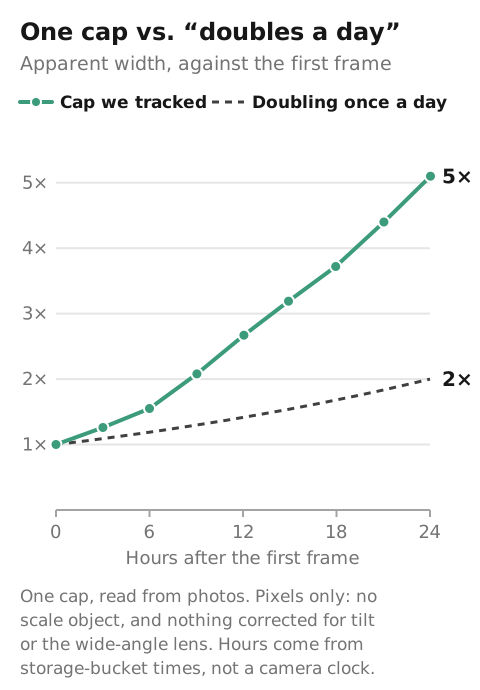
Treat those as rough: pixels, not millimetres, with no ruler in frame. Caps tilted toward a wide-angle lens and rims unfolded, which we can't correct for. On the tracked cap we can't size the error: cloth hid its right side throughout, and most of the gain came at a left margin that may have swung as well as grown. The firmer check is the cap behind: its right end started clear of the cloth and finished under it, so cloth can only have lowered its 2.9 times. Tilt, uncurling or the lens would have to inflate that at least 1.45 times to leave a doubling. "Looks conservative" covers these 24 hours, not other days, blocks or species.
Other timed runs: blue oyster and king trumpet.
Do mushrooms keep growing that fast until harvest?
Not all the way: in one study, growth relative to the day before falls as the cap nears full size. The cap diameter of the oyster Pleurotus ostreatus 'Gonji7ho' ran at 285.5%, 182.2%, 129.4% and 103.8% of the previous day, days 5 to 9 after scraping its bottle to trigger fruiting (Ryu and Na 2023), so only the first step clears a doubling. These are group means at 18°C, not one tracked cap (our translation).
The authors put its best harvest at day 7 (our translation; another passage says day 8), so the slowest steps come at or after picking. Our cap eased too, but was still adding its most apparent width per hour when the frames stop, so they can't show those steps. Go by the cap's edge, not a doubling count (our advice).
Why do mushrooms grow so fast?
Often because cells swell and take up water, though it varies by species. The 21st Century Guidebook to Fungi says most shape changes as mushrooms develop "depend on cell inflation" (Moore, Robson and Trinci). From about 20 to 100 mm long, a Coprinopsis cinerea stem gets five times longer but only "doubles its fresh weight" (§12.13), which is why "which size?" matters (our reading). But shiitake caps expand by making more threads (§12.13), and the oyster P. pulmonarius cap margin is "a region of active growth" (§12.7), so don't assume oysters only swell (our reading).
Do mushrooms grow overnight?
They can look like it, but the fungus was there first: a tiny unopened mushroom "absorbs water and quickly expands (think of a water balloon)" (Chicago Botanic Garden). In lawns they may follow "excess rain or irrigation" and are "rarely indicative of a lawn disease" (UMN Extension). That's the grass, not your safety: don't eat them and keep dogs away (our advice), because "a small number can make one seriously ill or even lead to death" and some "may be deadly toxic to dogs" (Chicago Botanic Garden).
How can you tell if your block is on pace?
Your block is on pace if its caps visibly gain size between same-angle photos and reach full size roughly within your species' range above (our advice). There's no single number, and our caps' three to five times is not a target. Pins that stop growing are a different problem, usually too little humidity (North Spore help center).
In Hypha, tap the Add Photo camera icon each day from the same spot (phone only). Open a photo, tap the three-dot More options menu → Compare Photos, pick two photos, then More options again → Slider or Overlay. Under Strains, a strain's Performance section shows your own medians in its Bulk card once bulk blocks finish: To fruiting (block start to fruiting conditions) and To harvest (fruiting conditions to first logged harvest). Compare this block with those (our advice); neither counts from pins, so they won't match the days above.
Hypha doesn't measure growth, so you judge by eye. Download Hypha; the free plan holds 25 active blocks.